According to global GDP indicators calculated using purchasing power parity (PPP), China, the economic leader at the beginning of the 19th century, has given way to the British Empire.
As Yeniavaz.com reports, citing The Maddison Project database, in the 20th century, economic leadership shifted from Great Britain to the United States. Currently, economic power is once again shifting toward Asia.
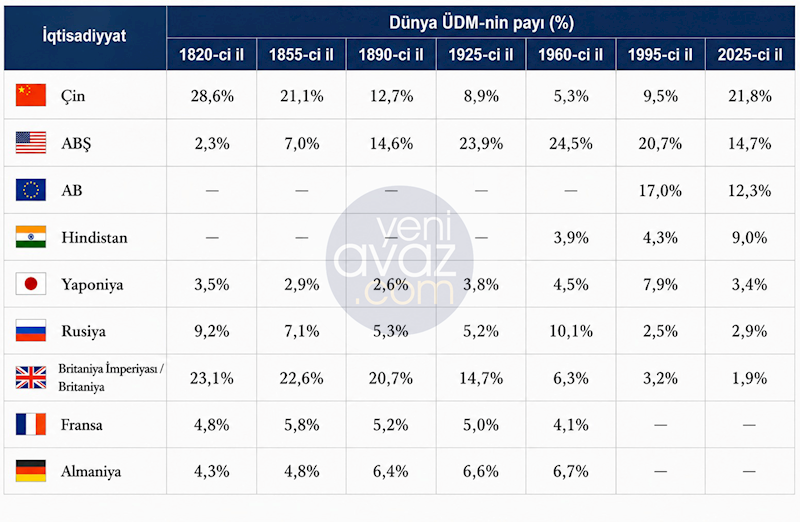
In 1820, China was the largest economy, accounting for 28.6 percent of global GDP. At that time, the British Empire's share was 23.1 percent, while the United States' was only 2.3 percent. Driven by the Industrial Revolution, Great Britain emerged as a global economic power in the 19th century, increasing its share of global GDP to 23.8 percent by 1845. In the 20th century, leadership shifted to the United States. During World War II, in 1944, the United States reached its highest share in two centuries, accounting for 29.7 percent of global GDP. The country's economic dominance is reinforced by its leading positions in high-tech industry, manufacturing, finance, and international trade.
However, in recent decades, the economic balance has shifted in Asia's favor. Thanks to economic reforms and its transformation into a manufacturing hub, China has regained its top spot, accounting for 21.8 percent of global GDP in 2025. The United States' share fell to 14.7 percent in the same year.
India also continues to grow. In 2025, its share of global GDP reached 9 percent, the highest in its history. China and India together account for 30.8 percent of global GDP, demonstrating Asia's growing role in the global economy.
Over the same period, Europe's economic weight has declined significantly. While the European Union accounted for 17.9 percent of global GDP in 2007, this figure fell to 12.3 percent by 2025. The British Empire, on the other hand, has seen its share decline from a peak of 23.8 percent in the 19th century to just 1.9 percent in 2025.
The data shows that while global economic leadership has shifted from China to the United Kingdom and then to the United States over the past two centuries, in the 21st century the economic center of gravity is shifting back to Asia. Experts believe that the continuation of this trend will largely depend on how China manages to address its demographic challenges, improve productivity, and increase economic growth.
Elnur Ali

 Tətbiqimizi yükləyə bilərsiniz