Tasnim News Agency reported that the Iranian government has decided to ban the export of all food and agricultural products.
Yeniavaz.com reports that Azerbaijan is one of the main countries to which Iran exports food products.
It should be noted that Iran is considered one of Azerbaijan's main trading partners. Specifically, Iran is Azerbaijan's leading trading partner in food imports after Russia and Turkey.
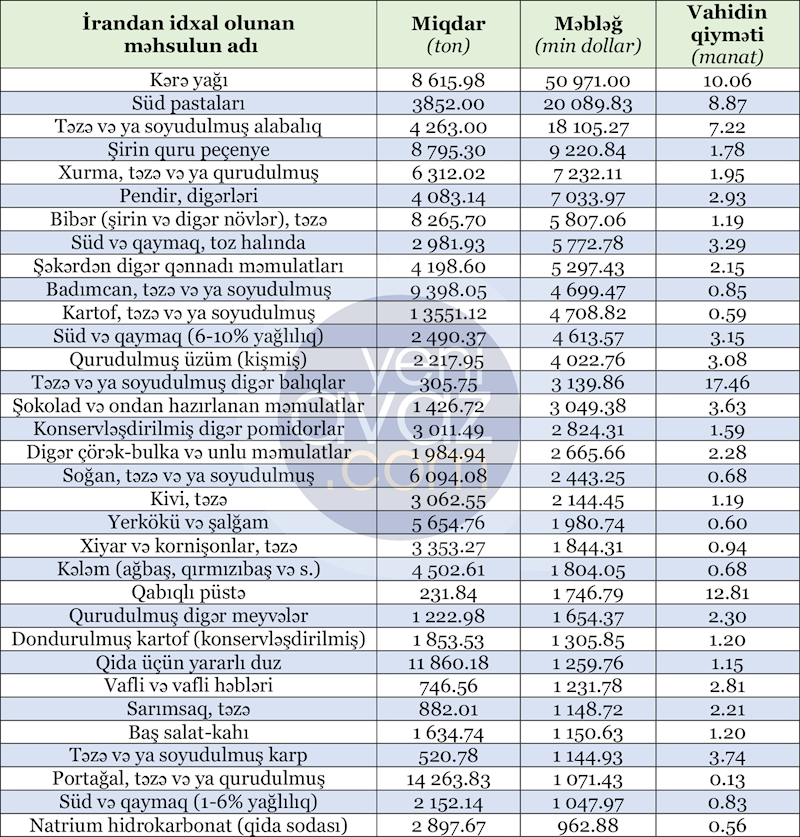
For reference, last year, Azerbaijan imported $624 million worth of goods from Iran. Iran's share of many food imports is quite high. For example, last year, 43% of imported butter, 93% of cabbage, 98% of carrots, 95% of eggplants, 75% of dates, and 30% of garlic came from Iran.
So, what impact could Iran's ban on food and agricultural exports have on Azerbaijan?
Economist Allahverdi Aydin, in an interview with Yeniavaz.com, notes that a significant portion of food imports from Iran account for the staples on our tables:
"If this information is accurate, it means that a large portion of the country's important food imports could disappear from the market in a short period of time. Since dependence on some products is high, prices for these products could rise sharply until alternative import sources are found. Immediately filling this gap with the Russian or Turkish market would be more expensive, both logistically and financially. For example, Azerbaijan is heavily dependent on imported butter. Approximately half of its imported butter comes from Iran. Consider that, amid rising prices for butter imported from Europe and New Zealand, Iranian butter was considered the most affordable alternative on the domestic market. If Iran cuts off this low-cost import channel, consumers will be forced to switch to higher-priced European or New Zealand butter. This would be a serious blow to the average family budget."
The table lists some of the main food products imported by Azerbaijan from Iran last year:
Elnur Ali

 Tətbiqimizi yükləyə bilərsiniz